Category Archives: Personal Experience

How’s Married Life?

Grace and I will be celebrating our first anniversary this coming Sunday, June 11th. While it’s difficult to grasp it’s been a whole year already, it’s also becoming harder and harder to remember our lives before it.

Happily ever after, right? No, life’s ups and downs continue to go on, and we thought we’d share some reflections on our one year of marriage so far.

Read more of this post

The Virtues of Living in a Small Apartment

In Empires, the tenth and latest expansion to the game Dominion (one of my favorite games), there is a Landmark called Wall that changes the rules of the game to penalize every player by a point for every extra card in their deck beyond the 15th.
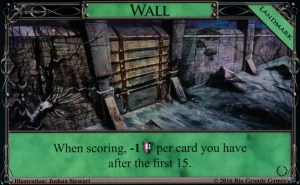
Wall

If you’ve played Dominion before, you probably recognize that this makes any cards that trash cards from your deck super valuable, like Chapel:
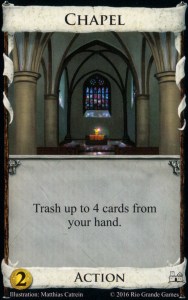
Chapel

And people wonder why religious conservatives support Trump… 😛

Chapel is already widely considered the strongest card in the game for its cost, because trashing the relatively bad initial cards can dramatically increase the average value of your deck. But with Wall, it becomes even more important to cut down on the low-value cards, since they actually start hurting you.

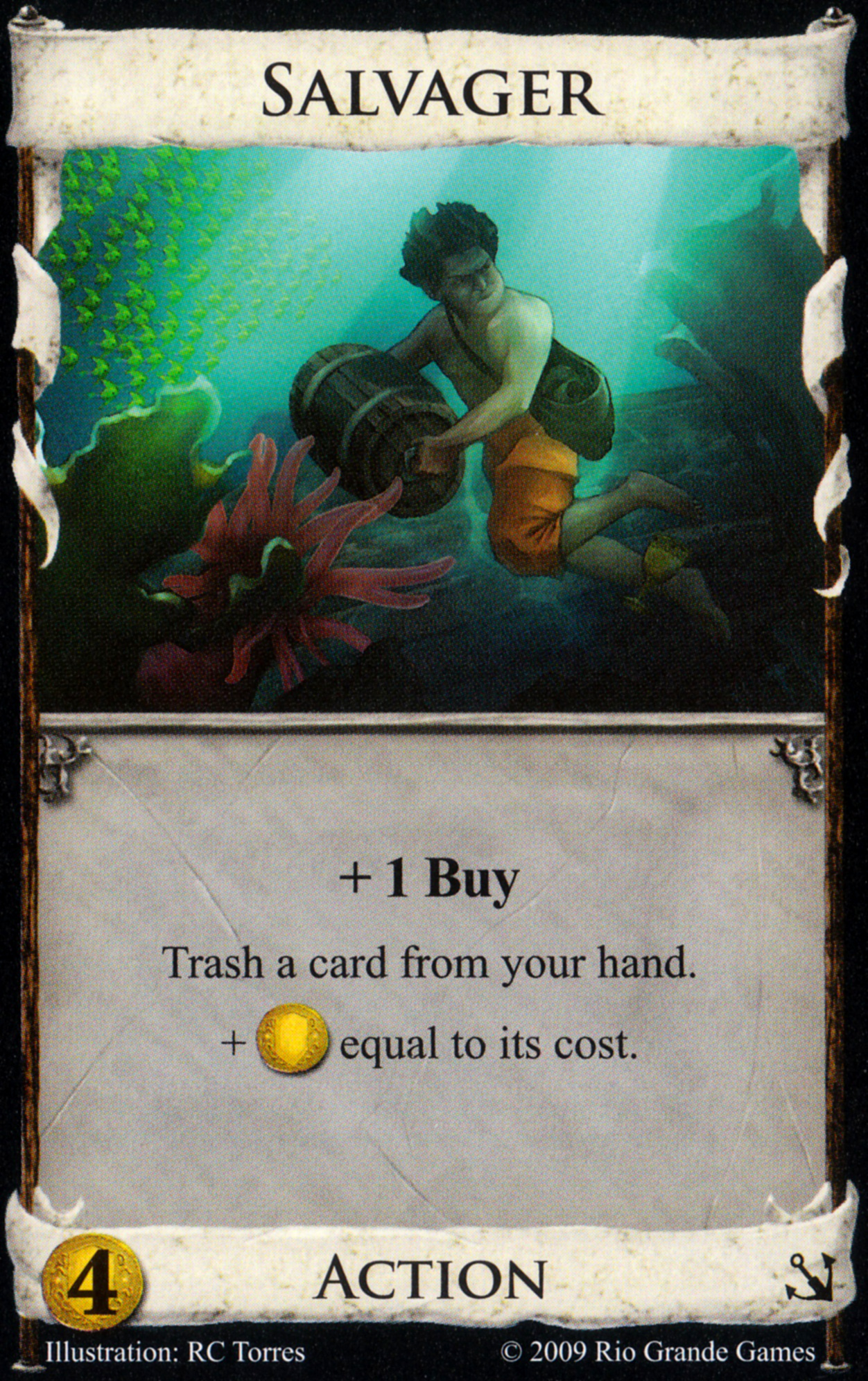
There are other types of trashing cards that give you some sort of benefit depending on what you trash. A classic from the Seaside expansion is Salvager:

Salvager

Salvager isn’t quite as powerful as Chapel when playing with Wall, but it does let you keep your deck lean as you keep improving cards. These so-called “trash-for-benefit” cards tend to make it even more reasonable to exchange your best non-victory cards in the late game, since this way, you get some added value out of them, and with Wall, an extra point from not having them in your deck anymore.

Events, another new innovation from the last two Dominion expansions, also allow you to improve your deck in some way without adding cards, which is more valuable when playing with Wall. If there aren’t any Events or trashers, though, playing Wall becomes especially interesting. Every player who doesn’t sit on their hands will be losing points to it, but it’s still not enough to offset those 6-point Provinces or 3-point Duchies, so perhaps your strategies might look similar on the surface.

With Wall, though, you are forced to consider tradeoffs in a different way: maybe it isn’t worth the 1-point loss to buy anything if you only have $3 or $4, even as early as the mid-game. Estates (which only give 1 point) are now completely useless, so you might as well ignore them. In other words, your standards for what is worth buying go up, as your calculation is no longer about whether a card would improve your deck, but whether it would improve your deck by enough.

Why do I bring up the strategy around this one particular card in Dominion? Well, I’ve realized that living in a relatively small apartment has very much the same feel, and we’ve found ourselves adapting all of these strategies from time to time. Yes, this is another post where I derive life lessons from a board game.

Read more of this post

Stop Ignoring Impact Multipliers

I love to play board games, especially in this golden age we’re in. Every once in a while, I learn a new way of thinking from a board game. In this post, I’d like to share one general lesson that I learned from one of my favorite strategic board games, Navegador. This lesson actually succinctly encapsulates key messages from several of my recent blog posts, among other thoughts I’ve had recently.

Read more of this post

The Hard Problem of Teaching

Tomorrow, we have our final classes of the year in IdeaMath, a weekend contest math program run by former US International Math Olympiad team coach Zuming Feng that I’ve been teaching at for the last five years. It’s always tough to say goodbye, having spent over a dozen Saturday afternoons with these middle and high school students, helping to teach them problem solving skills and having some fun along the way.

I’m not yet sure whether I’ll be returning to the program in the fall during my last year of grad school here, so this could be my last regular teaching opportunity in grad school, or possibly ever. I joined IdeaMath in my first year partly as a way to give back to the math contest community that I grew up in, and partly as a way to keep up my involvement with teaching while in a graduate program with a light teaching load.

My teaching experiences at MIT were also very positive — in fact, between the teaching I’ve done online with the Art of Problem Solving, Caltech, and MIT, I’ve somehow managed to help teach five different calculus classes. Some were aimed at the strongest students, and some at the weakest (albeit the weakest Caltech and MIT students). Some attempted to be fully rigorous, while others simply provided an upgraded version of Calculus BC. All were very rewarding personally, as I got to see students grasp the material for their first time.

Given my experiences and passion for teaching, I’ve often been asked if teaching is a career I’d consider. The question makes sense; I like to teach. I enjoy being able to inspire another generation of students with neat tricks, clever ideas, and powerful results. Even more than inspiring, I enjoy bringing clarity, helping students better grasp important concepts and form appropriate intuitions around them.

That passion and experience has made me into quite a proficient teacher, if I do say so myself. The MIT Math department administrator was quite impressed with my teaching ratings from students at MIT and my senior year at Caltech, I received a teaching prize meant for graduate students for my TA work there. In a surreal turn of events, one day the Caltech math department head called me into his office, wondering if he could pay me to essentially rescue a statistics class that had gone awry from poor teaching by holding a bunch of recitations and office hours. (I turned him down since I was too busy at that point, and suggested that he make the same offer to a few of the TAs instead.) Given my false starts with various research projects in grad school, it seems pretty clear that I’m generally better at teaching than research.

And yet, despite this passion, experience and success, I actually don’t see myself continuing to teach full-time or long-term. Why not?

Read more of this post

Why I Got Into Cooking

Last Thursday, I had the fortunate coincidence of being visited by two of my best friends from college, Timothy Johnson and Peter Ngo. They had both been to Boston back in June 2016 to serve as groomsmen in my wedding, but I hadn’t seen them since. Their trips were independent, but happened to overlap on Thursday, which also happened to be the best day for them to visit me and Grace.

With both of them visiting, along with Tim’s girlfriend Xiao, Grace and I decided to host them at our apartment and make a whole feast of Indian food. We had just recently learned how to make Chicken Tikka Masala, Palak Paneer, Aloo Gobi, and Chicken Tandoori, and we decided to serve all four to them, employing all three of them in the kitchen chopping vegetables and measuring spices.

John Shen, another college friend of ours (and Peter’s host) joined us as well, and he remarked after dinner that he was somewhat surprised that I had gotten excited about cooking. Reflecting, I realized that in the moment, cooking four dishes of Indian food, while more than usual, seemed like just a natural extension of the habits Grace and I had built up over the course of a year. We would actually go on to cook Pad Thai and bake bread for our board game group on Saturday and then turn around and make enchiladas for some of the Et Spiritus journal club team on Sunday. Cooking for three different groups of friends in four nights was certainly beyond our usual pace (and not exactly sustainable), but not by much. It’s worlds from where I was at the beginning of grad school.

So how did we get to this point? Let me walk through some of the factors and explain a bit of our philosophy behind cooking and hosting.

Read more of this post