Category Archives: Philosophy

The Spiritual Side of Board Gaming

Last week, I introduced what I’m calling the Golden Age of Board Games. As I explained in that post, there are many more and a wider variety of board games coming out every recent year than the world has ever seen. In a century that seems to bring more bad news than good, this is a bright spot many of us can cling to.

Yet, with such a new and bountiful world to explore and play in, we’d be remiss if we jumped right in without giving this fairly new activity more thought. As a Christian, I have thought a lot about how the board games I play — and the way I play them — affects me, my relationships with others, including God.

Read more of this post

The Fractured Republic by Yuval Levin: Summary and Review

In the midst of a very unusual presidential campaign, it can be difficult to think past the election in November. To try to grasp a wider perspective and see around the corner to the most useful politics of the future, I decided to read The Fractured Republic by Yuval Levin, hearing about it from this review. Levin is a conservative intellectual, but the book comes highly recommended by thinkers on both the left and the right, and deservedly so, as I would soon discover.

Not everyone has the time to read hundreds of pages, so I thought it would be useful to summarize it here. If you’re at all intrigued, I would highly recommend reading the full book, of course. Levin builds his theses very thoroughly and convincingly, and seems to describe quite accurately a wide variety of perspectives on recent history, not just his own. His writing is appropriately nuanced and footnoted in a way that this condensed version inevitably will fail to be.

Read more of this post

Getting Serious About Gluttony

(This article was also published in the first issue of the new MIT Et Spiritus Christian journal. Thanks to Richard, Taylor, and Erik for helping to edit it to this final form!)

In August, I was listening to a sermon at church about how to recognize and defeat sin and temptation. I was struck by how many of the examples came from ambition, pride, the usual notion of the American Dream, and how I didn’t feel like I personally related to those temptations. As I searched in my mind for a personal application, gluttony came to mind. I love the pleasure of eating good food, often to a fault.

So I resolved to fight gluttony in my life, and as we moved to our time for response, I was struck by the irony of taking communion to fight that particular sin. To my surprise, whoever had prepared it that week had cut the pita bread into very small pieces, the smallest I’d seen. “Thanks, God,” I quietly prayed as I returned to my seat.

Further confirmation came later that week, when I came across a guest post in Christianity Today on the same issue. It’s short and very well-written so I’d encourage you to read it, but this paragraph struck me in particular:

The first [call to action] is to take gluttony seriously. While we are beginning to address the problems surrounding our culture’s materialism, we want to skip over the strong wording in Scripture to avoid excess food. “Put a knife to your throat if you are given to gluttony”? In my 33 years of regular church attendance, I’ve never heard that Proverb addressed from the pulpit.

While I think that particular passage (Proverbs 23:2) has an important larger context that can’t be ignored, I would like to argue that there are both biblical and biblically-motivated reasons to care much more about gluttony than we do right now.

At the very least, it’d be hard to care less. Gluttony has become the “acceptable” sin in the conservative American church today. I remember when my high school church went through the Purpose Driven Life videos by Rick Warren, he casually mentioned that American Christians were having so many potlucks and food-based gatherings to build community, we were collectively encouraging each other to pack on the pounds. This didn’t seem to cause much more than a nervous chuckle.

On a more humorous note, Trevor Noah of the Daily Show discovered that a certain 2016 presidential candidate had worked food into pretty much every political discussion. Who would it be other than former Southern Baptist pastor Mike Huckabee? While Christians certainly don’t all agree with Huckabee’s politics, ask yourself: Does this surprise you?

Huckabee Food-Based Politics

At the same time, I see signs of the Christian world starting to wake up from our collective food coma and face the consequences of turning a blind eye to gluttony in our communities. John Piper’s ministry, Desiring God, has called gluttony America’s Most Tolerated Sin, offering a theological look at the struggle. Rick Warren eventually decided to do something about his weight, and crafted a biblically-guided diet called the Daniel Plan, an approach the Christian satire site The Babylon Bee recently skewered. Even Mike Huckabee himself lost 110 pounds and wrote a book called Quit Digging Your Grave with a Knife and Fork, something you didn’t see much of in the latest presidential race.

What more is there to add? First, we need to take a step back, define gluttony, and look at why it is a sin. I’ll then offer a few guidelines I’ve found helpful in moving to combat it, by way of analogy with more frequently-discussed sins in the American church.

In the end, I hope that we can talk about gluttony openly in our Christian communities and seek to not simply affirm our addictions to food. We live in one of the most gluttonous cultures of all time: Every American holiday has food at the center, from Thanksgiving turkey to Fourth of July barbecue to Super Bowl 7-layer dip. To cope, the country swings from one crazy diet (“no fat!”) to another (“no carbs!”) to another (“no gluten!”) every decade. (To be clear, some individuals are gluten-intolerant and have no choice in the matter, but the diet’s recent popularity far outstrips what is medically warranted.)

Yet instead of distinguishing ourselves from the surrounding culture, when it comes to gluttony, Christians are right there in the middle of the buffet line.

What is Gluttony?

Let’s start by looking at gluttony as a whole. What is it, and how can it be a sin?

For the purposes of this article, I’ll define gluttony as the inordinate desire for and consumption of food and drink. Let’s unpack that definition first. There are two components: the bodily action of eating and drinking “too much,” and the mind’s desire to do so. This mirrors other pairs of sins, like stealing and coveting. Normal hunger isn’t gluttony; we need to eat to live, but when that desire goes too far, it becomes gluttonous. While I’ll be focusing on food and drink, you could also easily extend most of these lessons to other aspects of consumer consumption.

Why is gluttony a sin? To answer that, we inevitably have to further explain how much is “too much.” Instead of giving us a formula or litmus test to assess our gluttony, God’s word gives us a series of examples to consider, which we’ll turn to now.

Exchanging the Gifts of God for a Meal

Eating and the consequences of eating show up at the very beginning of the Bible. In Genesis 3, Adam and Eve reject God and turn to food, specifically the fruit of the tree of the knowledge of good and evil. However, their choice is less about the food than the open rebellion it signifies; the tree of life is also present in the Garden, offering fruit that would give them eternal life.

The issue of gluttony in particular comes much more into focus at a pivotal moment for Isaac’s sons Esau and Jacob:

Once when Jacob was cooking stew, Esau came in from the field, and he was exhausted. And Esau said to Jacob, “Let me eat some of that red stew, for I am exhausted!” (Therefore his name was called Edom.) Jacob said, “Sell me your birthright now.” Esau said, “I am about to die; of what use is a birthright to me?” Jacob said, “Swear to me now.” So he swore to him and sold his birthright to Jacob. Then Jacob gave Esau bread and lentil stew, and he ate and drank and rose and went his way. Thus Esau despised his birthright. (Genesis 25:29-34)

Jacob and Esau

While Jacob was certainly very opportunistic in this passage, I’d encourage you to not just see Esau as a brain-dead victim of Jacob’s treachery. As the last verse summarizes, he didn’t really care about that birthright thing. The comfort of food was far more important to him than being part of God’s grand plan for mankind.

We don’t have birthrights to give away on a whim today, but we can still do much of the same thing on a smaller scale, missing the ultimately more important work that God has for us because we can’t just wait to eat. For a simple everyday example, think of all the times when you’ve eaten with a friend and paid more attention to the food you were eating than the conversation you were having.

This improper elevation of something mundane (the meal) over something eternal (the spirit of God in the person you’re eating with) is a prototypical example of idolatry in the Bible. In general, idolatry is any attempt to elevate something into the place of God in the believer’s life.

It might be strange to think about food as one’s god, but ask yourself: Where do you turn when you first get bad news? Do you kneel down in prayer, or run to the kitchen for some chocolate? In this way, “comfort foods” replace the “God of all comfort” (2 Corinthians 1:3-4).

Waste When There Is Need

The first half of Ezekiel is a very long judgment condemning Israel’s sinfulness, and in chapter 16, Ezekiel calls them out for being worse than Sodom, proclaiming:

Behold, this was the guilt of your sister Sodom: she and her daughters had pride, excess of food, and prosperous ease, but did not aid the poor and needy. (Ezekiel 16:49)

This is another way that gluttony can be sinful: if we have plenty of excess food but don’t help the poor with it. Let’s see, does this criticism apply to us?

One thing at least is clear: We waste a lot of food, to the tune of a staggering 133 billion pounds per year in the US, at just the retail and consumer levels alone! That’s over a pound per person per day. And yet, as we’re all aware living in a city, there is need right where we are. As Jesus predicted, the poor are still with us.

Let me be clear: I’m not saying that we should all get together our friends to participate in canned food drives, one of the least efficient means of charity out there. The Greater Boston Food Bank, to take one example, can feed someone for three meals on just a dollar. That can of soup you were thinking of donating just can’t compete with the economies of scale they can achieve from monetary donations.

Instead, we should work not to buy that extra can in the first place, and donate the savings to charities like the food bank. How much food do you buy that goes bad before you get a chance to eat it? Do you feel an excessive need to “stock up” on foods you like, even if it’s unlikely you’ll finish them in time?

We see here another way that food can be an idol: We can find our security in having more than enough to eat, rather than finding it in the Father of all good gifts. We would do well to heed Jesus’ words in the Sermon on the Mount:

Therefore I tell you, do not be anxious about your life, what you will eat or what you will drink, nor about your body, what you will put on. Is not life more than food, and the body more than clothing? Look at the birds of the air: they neither sow nor reap nor gather into barns, and yet your heavenly Father feeds them. Are you not of more value than they? (Matthew 6:25-26)

This lesson is one of the easiest to apply to other aspects of consumerism. Do you really need to go on that shopping spree? Is that new computer, phone, or tablet really worth the opportunity cost of not being able to feed someone else? (Remember: 33 cents per meal!) What level of security is God calling you to sacrifice to do his work?

Eating One’s Way Out of the Action

Finally, we come to the practical, down-to-earth wisdom of the Proverbs:

Be not among drunkards or among gluttonous eaters of meat, for the drunkard and the glutton will come to poverty, and slumber will clothe them with rags. (Proverbs 23:20-21)

If you have found honey, eat only enough for you, lest you have your fill of it and vomit it. (Proverbs 25:16)
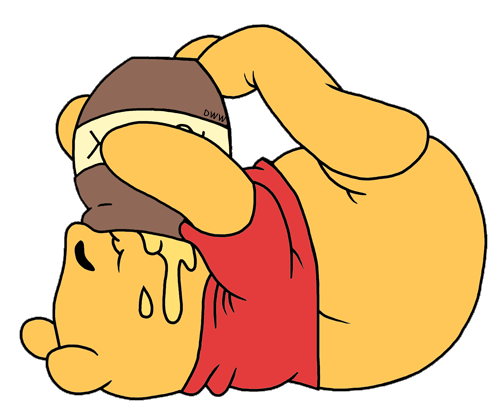
Pooh Honey

I love how clear and relevant the inferences in these proverbs are. Sometimes eating good food, and particularly meat, is expensive. If you eat too much, it’ll make you sick to your stomach. Food coma is a real thing, and falling asleep after a big meal can be disgraceful.

Yet sometimes these inferences are exactly what we need. I stopped eating sugary cereals like Cinnamon Toast Crunch on a regular basis because I noticed that I was going through a sugar high-low cycle shortly thereafter, and it wasn’t worth it. Now I drink Soylent for my breakfasts, which has a very low glycemic index and therefore moderates those swings much better.

On the financial side, food is also a significant portion of my budget as a graduate student, a little over $10 a day, third behind rent and taxes. And I already get a lot of free food at MIT, around a meal per day during the semester. Do you understand how much money you spend on food, and what you aren’t able to do without that money?

Beyond poverty simply being an undesirable state, we don’t want the consequences of our poor eating choices to keep us from being able to serve God. This is also the message some Christians have drawn with respect to health from Paul’s bold description of our bodies as the temples where we worship:

Do you not know that you are God’s temple and that God’s Spirit dwells in you? If anyone destroys God’s temple, God will destroy him. For God’s temple is holy, and you are that temple. (1 Corinthians 3:16-17)

Is that second piece of cake going to render you unable to think straight for the next hour? Will you fall asleep praying after going back for another round at the buffet? If your poor eating habits will cause you to die sooner than otherwise expected, is that really God’s calling on your life?

A Road Forward

I write all of this not as a CrossFit trainer ready to whip you into shape, but as a gluttonous recreational eater in even more need of hearing these words than you likely are. So when I offer suggestions, they’re much more of the beginning of a conversation than a complete diet plan that will work for everyone. If a diet plan is what you’re looking for, there are already plenty of them out there.

Instead, I hope to draw on experiences that Christians already have in handling sin in other domains, and show that these can also be brought to bear on this issue. In that way, I’d like to focus on the aspects related to sin, the portion of this issue that deals with our heart’s desires, rather than directly with the food itself.

Shine a light

Sin thrives when it is hidden, in the dark. John repeatedly urges us to instead “walk in the light, as he is in the light.” (1 John 1:7) We’re familiar with what this looks like for flagrant sins like marital infidelity: You shouldn’t try to cover up an affair, and be honest with your spouse when you’re tempted earlier rather than later.

For gluttons like me, this starts with buying a scale. I now weigh myself nearly every morning before I shower, and I’ve plotted the data for almost a whole year now. (Unsurprisingly, I lost the most when the weather was warmer, and gained some of it back in the winter. On a day-to-day basis, there’s a lot of noise, but it provides a quick reminder that I probably ate too much for dinner the night before.)

Just writing down my weight won’t make that number go down on its own, but it reminds me of my sins the night before. However, I will caution that focusing too much on metrics like this can be hazardous. If we elevate a low BMI or waistline to the position of God, that’s yet another idolatry. While I don’t have any personal experience with eating disorders, they seem like particularly awful instantiations of this idol.

The radical solution

A rich young man had obeyed the law all of his life. Coming to Jesus, he could sense that that wasn’t all, though. Peering into his soul, Jesus called him, just like he called his disciples: “If you would be perfect, go, sell what you possess and give to the poor, and you will have treasure in heaven; and come, follow me.” (Matthew 19:16). As we all remember, he went away sad, because he had many possessions.

Jesus knew what his sin was, greed, and sought to remedy it with a radical shift. He encouraged the same with Zacchaeus, the extorting tax collector who upon meeting Jesus decided to repay everyone he extorted fourfold and give half his enormous wealth to the poor. It’s clear that this isn’t the calling for everyone; Jesus doesn’t tell Mary and Martha to sell their home, and the wealthy Joseph of Arimathea donates his tomb to hold Jesus. But when it’s a sin that you personally succumb to far too easily, it’s important to be bold in the adjustments you make.

This applies equally well to food, and forms an additional justification for some forms of fasting. By removing the pleasure of food from our lives entirely, we can start to break its insatiable hold over us. (Of course, this isn’t the only reason to fast, just as combating our own greed isn’t the only reason to give. But it’s a motivation that can often be ignored.) Recently, I realized that I was addicted to my department’s daily free cookies, sometimes eating more than a meal’s worth. I decided the best way to break this addiction was not by gradually decreasing the number I ate, but by cutting myself off from them completely for a few weeks. Now that I’ve broken that fast, I find I now enjoy the best cookies in small numbers once again.

Rebuke a friend

Christians often talk about seeking “accountability partners” to help us navigate temptation. As Paul writes in Galatians 6:1, “Brothers, if anyone is caught in any transgression, you who are spiritual should restore him in a spirit of gentleness. Keep watch on yourself, lest you too be tempted.” We invite these spiritual siblings to examine certain parts of our lives and find ways we are not living up to God’s standards. I’ve seen friends do this with romantic relationships, regular Bible reading and even finances.

But I’ve never seen it with gluttony. (That is, except for parents rebuking kids, which is a bit of a different sort of relationship.) Instead, we tend to have the complete opposite effect together, encouraging each other to eat more at potlucks and other social gatherings, feeding the idol we’ve made of our taste buds. Even on social media, we share Tasty videos of making delicious food in seconds that increase our appetite further. (Seriously, as I wrote this, my Facebook feed showed me three similar videos in a row from completely unconnected fellow Christians! Why, people?)

At the same time, the spirit of gentleness is critical. Without it, rebuking gluttony turns into fat-shaming and unsolicited diet advice. There is still a lot of embarrassment around weight, and it’s not our responsibility to just wade into it all and tell someone they’re fat. We need to be willing to walk with them through their own personal habits and metabolic idiosyncrasies.

Flee temptation!

American Christians are often most familiar with sexual sin, including the struggle for many against porn. One of the most common verses we lean on for inspiration is 2 Timothy 2:22: “So flee youthful passions and pursue righteousness, faith, love, and peace, along with those who call on the Lord from a pure heart.” Simply don’t put yourself in a situation where you’re tempted. Some urges are just too strong.

The same approach can help for food. As much as we’d all like to be able to avoid overeating at a gourmet 11-course meal, we might have about as much success as in interacting normally with an attractive naked person. Handling such extreme temptations may very well be the ideal, but if we’re not there yet, we shouldn’t put ourselves in a position to fail.

For me, this means deliberately restricting access. I don’t normally keep any food within arm’s reach at my desk, and I don’t keep a lot of food available in my apartment anymore, especially easy snacks like candy or granola bars. I’ve seen the effect those temptations can have on me, and for where I’m at with fighting it right now, I need to stay away.


I still have a long way to go towards a healthy lifestyle, but I hope that we can jump-start this conversation for the sake of all of us who struggle to resist the tastiest food that the world has ever seen.

The Case for Kasich

I’ve spent an inordinate amount of time thinking about the US presidential race in the last several months. It’s become a bit of an obsession, so I figured I should write down a bunch of my thoughts once and for all. I recognize that commenting on a current election cycle has the very real risk of becoming very old news very fast, so I’d like to start by talking about a longer-term issue.

The Plague of Partisanship

Every political movement starts with something that it identifies as a problem to be fixed. Donald Trump says that America doesn’t win anymore. Bernie Sanders identifies the core problem as Wall Street. Marco Rubio says that Barack Obama has abandoned American exceptionalism (and knows exactly what he’s doing).

I’d like to offer a different take. Within my own lifetime, we’ve seen a rather disturbing trend that makes it impossible to fix any of these problems. No, I don’t think it’s money in politics — as far as I can tell, the politicians still reflect the voters who elect them. The giant detractor, affecting everything from healthcare to national security, mass shootings to abortion, is partisanship.

Pew Research came out with a fascinating multi-faceted report back in 2014 on this issue. They recognized trends in the last 20 years like these:

  • Growing ideological consistency: Believe it or not, in 1994, only 64% of Republicans were more conservative than the median Democrat (and 70% the other way). In 2014, those numbers were 92% and 94%.
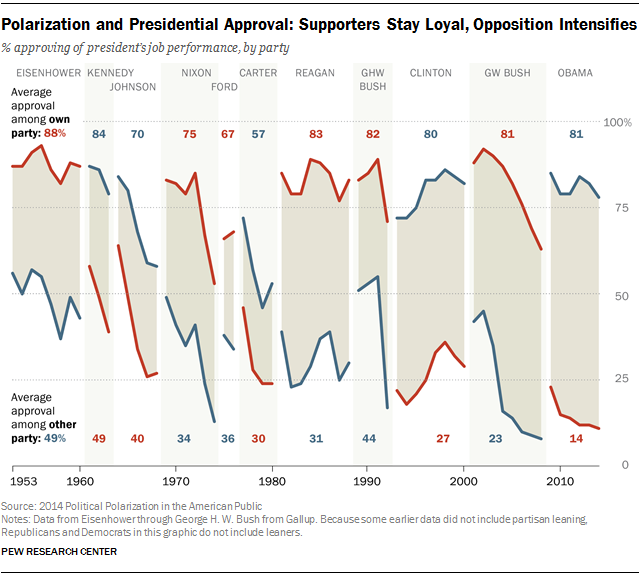
  • Growing partisan antipathy: Percentage with a “very unfavorable” view of the opposite party has gone from 16%/17% to 38%/43% (D/R). Obama’s, GW Bush’s, and Clinton’s approval ratings by the other party all broke records, descending from 27% to 23% to 14%, yet in-party approval ratings have held steady:
    Presidential Approval
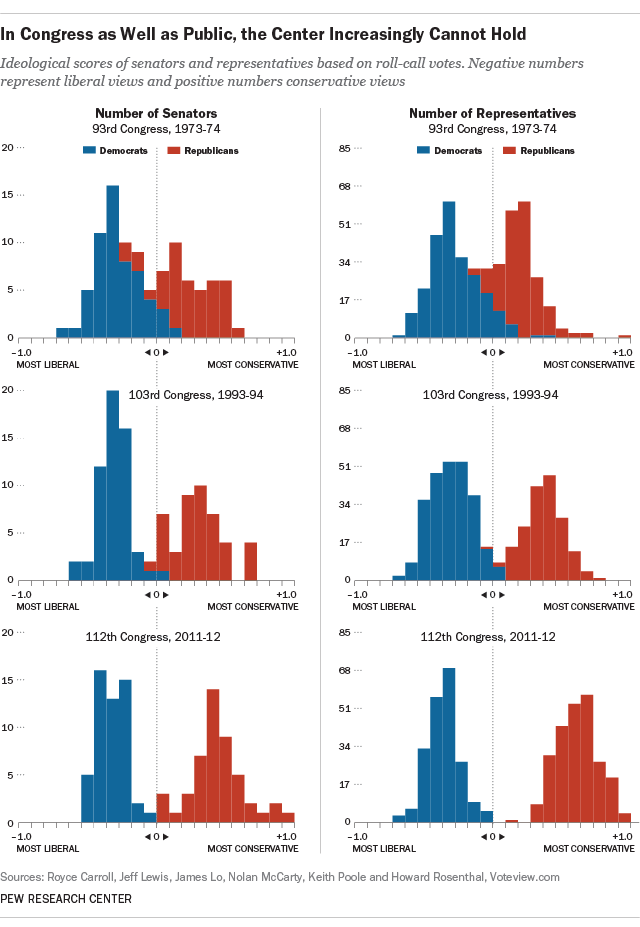
  • Correspondingly, in a separate report, Pew found that Congress is even more polarized than the public, with a noticeable gap between the most conservative Democrat and the most conservative Republican:
    Congressional Polarization

This has only gotten worse since 2014. Most recently, after Supreme Court Justice Antonin Scalia died, within a day, senators on both sides were proclaiming whether Obama would nominate his replacement, seeing the next justice as the tiebreaker between conservatives and liberals. Meanwhile, numerous news stories pointed out the robust friendships between Scalia and some of the liberal justices on the court, Ruth Bader Ginsberg and Elena Kagen. In contrast to Congress and the public, the justices’ bonds seem almost outdated, products of a bygone era of bipartisan collaboration in which we are no longer worthy to live.

Naturally, many believe that the other party is at fault for this partisanship. They declared war first! Yet both parties have been moving further apart on the ideological spectrum, as the viability of candidates like Cruz and Sanders show. Consider how out of place 2004 presidential candidates like George W. Bush and John Kerry would look in today’s Republican and Democratic parties just over a decade later.

Why has this only happened now, when we’ve had the same two-party system for over a century? Pew offers this partial explanation: Regional differences used to also be important, and offered contrasts on different axes than the current left and right, but mobility has aligned the axes. Liberals are now much more likely to want to live in cities, while conservatives want more space to themselves. The notion of “red states” and “blue states” only arose in 2000, though it feels like it’s been around forever now. I’d also add that the US hasn’t faced the need to unite to fight a common enemy, as we did in World War Two and to a lesser extent in the Cold War. Absent that greater sense of purpose, we’ve focused more on alternative visions of where our country should be going.

I sense a growing frustration with this suffocating political dichotomy. In October 2014, Scott Alexander’s Five Case Studies in Politicization raised the alarm by considering big issues that now feel so 2014: Ebola, ISIS, Ferguson, Rotherham, and global warming. Okay, a couple of those are still issues 16 months later. But anyways, Scott closes with this frustration:

I blame the media, I really do. Remember, from within a system no one necessarily has an incentive to do what the system as a whole is supposed to do. Daily Kos or someone has a little label saying “supports liberal ideas”, but actually their incentive is to make liberals want to click on their pages and ads. If the quickest way to do that is by writing story after satisfying story of how dumb Republicans are, and what wonderful taste they have for being members of the Blue Tribe instead of evil mutants, then they’ll do that even if the effect on the entire system is to make Republicans hate them and by extension everything they stand for.

I don’t know how to fix this.

I didn’t have any idea either, until this election cycle.

Meet the Prince of Light

Ohio governor John Kasich entered the presidential race somewhat late, in July of last year. He started to pick up a bit of momentum early with his robust defense of helping the mentally ill by expanding Medicaid. He faded for a bit, though, as attention diluted over the record 16 major Republican candidates. But in the last couple months, he’s found his voice, decrying the partisan rancor and negative advertising that has dominated the primary season. Here he is after his second-place showing in New Hampshire, when some of the country first learned who he was:

http://www.cnn.com/video/api/embed.html#/video/politics/2016/02/10/john-kasich-new-hampshire-speech-sot-ac.cnn

At the South Carolina Republican debate, the unifying nature of his message came into most stark contrast on the question of nominating Scalia’s replacement:

KASICH: Well, John, first of all, if I were president, we wouldn’t have the divisions in the country we have today. And I do wanna take a second as we reflected on Judge Scalia, it’s amazing. It’s not even two minutes after the death of Judge Scalia, nine children here today, their father didn’t wake up– his wife– you know, sad, but– you know, I just wish we hadn’t run so fast into politics.

Here’s my concern about this. The country’s so divided right now, and now we’re going to see another partisan fight taking place. I really wish the president would think about not nominating somebody. If you were to nominate somebody, let’s have him pick somebody that is gonna have unanimous approval and such widespread approval across the country that this could happen without– a lotta recrimination.

It does hurt to see Scalia’s death tightening the ranks on each side, as all of the GOP senators on the appropriate committee refuse to schedule hearings while liberal senators cry foul. It’s not going to get any nicer once Obama selects someone, as he says he will.

How will Kasich solve this problem? He realizes correctly that the strength of the United States is not our unanimity, it’s our unity amidst diversity. The solution to growing disconnect is to allow the major different visions for where this country should be going their own autonomy. This is precisely why so much of Kasich’s campaign is about returning power from the federal government to the states, whatever the issue, from education to infrastructure to job training to health care. This reminds me in many ways of Scott Alexander’s Archipelago vision.

Letting states decide more would actually solve many of the problems of polarization. If the country is so divided into red states and blue states, let each do their own thing as they see fit. Over time, the best innovations will shine and spread. The impressive agility of a small country like Singapore suggests that nationwide experiments are not the best way to introduce change. We’re already seeing this now as some states experiment with marijuana legalization. Over time, we’ll be able to tease out the effects and decide whether this is a good idea everywhere.

On social issues, Kasich seems to have the most consistently Christian message out there. He minces no words about the crime of abortion, and recently defunded Planned Parenthood in his state. But just as important to him is the lifting up the most vulnerable adults, particularly the mentally ill and addicted. It’s high time Christians involved in the political sphere were passionate about lifting all of the downtrodden, not just the victim classes that one partisan side has claimed.

This compassion has led to some very touching moments in Kasich’s town hall gatherings, as he empathizes with the crowd. A recent exchange in South Carolina went viral, and for good reason:

Moments like that alone almost make the campaign worth it even the governor didn’t stand a chance to win. As Joe Klein describes in Time:

Kasich, who seems truly transformed by this campaign–in a good way–was also talking about the comforts of citizenship. He was suggesting that there was an antidote to all the free-range anger out there–lazy, uninformed, self-indulgent, media-induced anger–and it involved prying ourselves away from the flat-screens that rule our lives and becoming part of a community again.

This was immediately dismissed–it was called “chicken soup for the soul” politics–by too many of my colleagues. They pointed out that […] Kasich was probably doomed in South Carolina and the rest of the red-meat South. In fact, Kasich has run a beautifully weird, unscripted campaign–talking about how to actually make government work, as he has as governor of Ohio, offering his flagrant humanity and refraining from negative ads. There was clearly no long-term place for that sort of thing in American politics.

Or is there? There’s something about unscripted campaigning: It allows the candidates to get better over time, as they learn to relate to the people they meet.

Kasich Is Electable

The major criticism of Kasich has been that he simply doesn’t have a chance in this primary. This argument has been especially prominent lately, as fears of a Trump sweep have led some to encourage Kasich to drop out. For instance, Ross Douthat hesitatingly suggests and then defends that perhaps Rubio should offer Kasich the vice-presidential slot in exchange for his endorsement, analyzing the pro’s and con’s.

Let alone the fact that Kasich doesn’t want that, I’d argue that it would fall far short of fixing the problem of partisanship. The centrist Biden hasn’t been able to tame the passions of the partisan Obama, and Rubio’s continual attacks on Obama will only make Democrats less likely to cooperate if he is president.

In any case, many commentators are struggling to find a path for Kasich to gain enough support to win the primary. The best Douthat can offer is this:

Kasich becomes the nominee by first having Trump run the table in the South on Super Tuesday, thus effectively killing off Ted Cruz and putting Rubio back on life support; then Kasich narrowly beats Trump in Michigan and Ohio and Illinois on March 8 and March 15th while Rubio loses Florida to the Donald, ending the Florida senator’s hopes; and then, with Trump ascendant, Kasich becomes the last-hope choice of every not-Trump voter and donor and runs the table in the blue state primaries in April.

If that’s the best that the brilliant Douthat can come up with, what hope is there? Let me start by offering a few simple observations:

Kasich is on the rise. He’s seeing bigger and bigger crowds in the March 1 states than he got in South Carolina, which were bigger than the ones in New Hampshire. He’s rapidly expanding his campaign infrastructure to compete broadly, and choosing to focus on that rather than compete in the very unfriendly South Carolina and Nevada. Kasich is touting his favorable head-to-head matchups with Clinton, and picking up more billionaire endorsements.

Contrast this with the faded and fading candidates who will drop out first: Jeb Bush had been on the decline for months, burned through all of his cash and family connections to compete in South Carolina, and went out with a whimper. Ben Carson similarly proclaimed that South Carolina would treat him better before coming in last there; he’ll probably drop out very soon. Even Cruz is busy putting out fires, from firing his campaign spokesman to pulling ads off the air to avoid controversy.

All of those campaigns have already peaked in prominence: Bush when he raised a bunch of money, Carson when he caught Trump in national polls, and Cruz when he won Iowa. Kasich is just beginning to pick up steam, and the only question is if his peak will come too late.

Bush’s exit will boost Kasich the most. PPP released a detailed poll in South Carolina that among other things, asked whether voters preferred a mustard, tomato, or vinegar based barbecue sauce. More relevant to the election, they asked which candidates their second choices were (on the top of page 8). Here’s the table:

  • Bush supporters -> Kasich (26%), Rubio / Carson (19%), Cruz (11%), Trump (8%), Undecided (17%)
  • Carson supporters -> Trump (21%), Rubio / Cruz (15%), Bush (13%), Kasich (8%), Undecided (28%)
  • Cruz supporters -> Rubio (32%), Carson (25%), Bush (13%), Trump (11%), Kasich (8%), Undecided (11%)
  • Kasich supporters -> Bush (30%), Trump (18%), Rubio (17%), Carson (10%), Cruz (9%), Undecided (17%)
  • Rubio supporters -> Cruz (25%), Kasich (21%), Bush (18%), Trump (13%), Carson (7%), Undecided (16%)
  • Trump supporters -> Rubio (20%), Cruz / Carson (19%), Kasich (16%), Bush (11%), Undecided (15%)

It’s not a big edge, but voters in South Carolina seemed to be more frequently deciding between Bush and Kasich than between Bush and Rubio. Of course, I’d love if someone compiled all of this second-favorite-candidate data across many different polls, but this at least passes the eye test. Rubio is more in the conservative lane than the “establishment” lane with the governors.

On top of that, the Bush Super PAC will no longer be airing all of its negative ads against Kasich. I don’t have the numbers handy, but Bush’s Super PAC, Right to Rise, probably spent more in negative ads against Kasich than he was able to spend for himself.

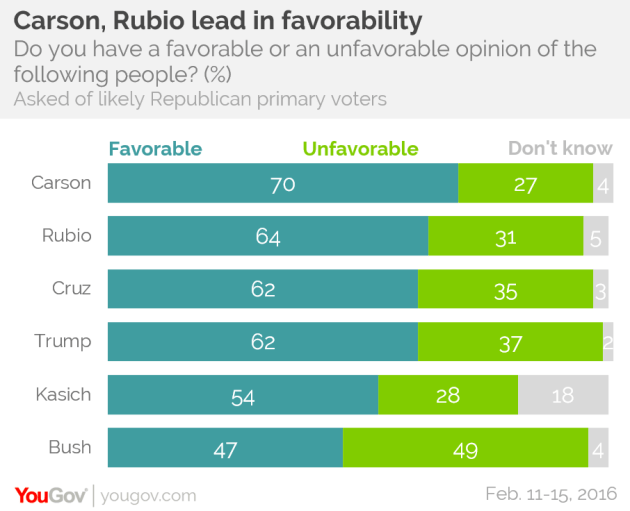
Kasich has the most to gain from a narrower field. The biggest knock against Kasich is that he’s boring. He doesn’t appreciate the edge that politics has taken, and has refrained from the negativity. As a result, many people simply haven’t heard of him. Now, with only four or five candidates left, he will finally get a chance for people to hear who he is. Here’s a recent favorability chart among likely Republican voters:

Favorability Ratings

Among these six candidates, Kasich has by far the largest percentage who don’t know him. But this also gives him the most opportunity to rise with voters who haven’t been paying nearly as close attention to the race as I have. Maybe even viewers like you.

No one can land a punch on him. In the New Hampshire debate, there was a remarkable contrast. Right before Rubio repeated his memorized Obama line for the fourth time (“He knows exactly what he’s doing!”), Governor Christie was asked if he wanted to criticize Kasich’s record, and he basically said no, he didn’t: “He’s done a very good job as governor of Ohio.” Now, Christie and Kasich are friends, so I can understand that they wouldn’t want to fight. But that debate contrasted how much more vulnerable Rubio is to a concerted attack than Kasich.

Even Trump has said positive things about Kasich the couple of times that Kasich has argued a similar point to him, leading some to speculate that he too might choose Kasich as a VP. Now, all of that might change with Trump’s favorite punching bag out of the race, but he seems pretty content to go after Ted Cruz for now.

With these things in mind, let me try to plot a path for Kasich that I find a bit more likely than Douthat’s:

  1. Carson drops out in the next couple days, leaving only four spots on the debate stage on Thursday, and longer speaking time for each candidate.
  2. With the increased media exposure, Kasich rises to the mid-teens in national polls, to nearly the same level as Rubio.
  3. Cruz and Rubio target each other heavily, with even more negative attacks, driving both of their favorability ratings down and increasing both candidates’ irritability and nervousness. Meanwhile, Kasich continues to be renewed by the positive messages he hears. Trump continues to assault Cruz and starts to find new things to criticize Rubio for.
  4. Among the remaining candidates, Kasich contrasts so sharply with the others in terms of civility, experience and optimism that voters with desires in those directions flock to him. Bush made experience look like entitlement, and without that negative association, Kasich’s experience becomes a big plus.
  5. Despite downplaying the results, Kasich picks up the most late-deciding voters and gets at least a handful of second-place finishes (maybe three out of MN, VT, MA, TN, VA?) on March 1st, which surprises many who already count him out. All of these states award proportionally, so Kasich will pick up handfuls of delegates from those finishes. After Super Tuesday, he is still in fourth in delegates, but Cruz and Rubio split their votes relatively evenly with Trump in the lead. In particular, Cruz wins Texas, keeping him in the race a while longer.
  6. As the pressure builds to rise, Rubio cracks again in a way that brings his inexperience to the forefront of voters’ minds, and makes them rush to Kasich the way they did in New Hampshire.
  7. Hillary Clinton does particularly well in almost all of the Democratic primaries on Super Tuesday, making the Democratic nomination seem over. Many independent moderates flock to the Republican side to support Kasich in open primaries in Michigan, Illinois and other important states for him.
  8. A win in Michigan on March 8th propels Kasich into 1st in the winner-take-all Illinois, Ohio and Missouri, jumping his delegate total into second place overall. Meanwhile, Trump and Rubio focus their efforts on Florida, which Trump sees as his best opportunity to defeat Rubio once and for all. Rubio ekes out a victory, but is severely weakened by having to focus on defending his home state. Cruz drops out around this point.
  9. One-on-one, Kasich’s sincerity and compassion disarm Trump’s vicious attacks which come with the narrower field. Midwestern Wisconsin (4/5), Pennsylvania (4/16), Indiana (5/3), and Nebraska (5/10) help Kasich make up remaining ground with Trump, before the finishing blow in California (6/7) and New Jersey (6/7). Edit: Looks like I misread who Christie was going to endorse… Strike New Jersey off that list.

Far-fetched? Maybe a little. But Kasich does actually have a more favorable schedule for catching up after falling behind than Rubio or Cruz, especially once the Democratic nomination effectively wraps up. After all, Florida is a closed primary, but Ohio is open. And the media exposure of the next week or so, without any more results coming in, will give him a chance to introduce himself to the people who would vote for him but simply haven’t heard his message yet.

How does the math work out? The 9 winner-take-all states I listed alone provide 609 delegates, about half of the delegates needed to win the nomination. The other 45 states and territories could provide the remaining 600, with more towards the end of the schedule as the race deepens.

Let’s be honest: If I were betting (and I’m not), I wouldn’t take this scenario as likelier than 5-10%. But I think Kasich’s message is worth a blog post to try to promote before it’s too late.

First and Second Order Motivations

How do you decide what to do in life? How do you weigh different options? We all make small decisions every day: Do I take the stairs or the elevator? Walk, drive, take public transportation, or Uber? Cook, eat out, grab fast food, or drink Soylent? Attend class or skip? Go to bed early or get some more work done? Read a book or watch TV or Netflix in my free time?

We also make some decisions that have bigger implications for our lives: Where do I go for college? After college, do I get a job or go to grad school? Take a job with higher pay and longer hours or less pay and shorter hours? Work, volunteer, or pick up a hobby on the side? Date casually, seriously, or not at all? Have a child or focus on career? Move to another city or country or stay where I’m at? These problems are harder, but we all know they matter a lot. Read more of this post